Mark Richards
SOA and Integration Architect, Author of Java Message Service

Mark Richards is a Director and Senior Architect at Collaborative Consulting, LLC, a Boston-based Business and Architecture Consulting Firm, where he is involved in the architecture, design, and implementation of SOA, EDA, messaging, and other architectures, primarily in the Java platform. Prior to joining Collaborative Mark was an Executive IT Architect with IBM, where he worked as an SOA and enterprise architect in the financial services area. He has been involved in the software industry since 1984 and has many battle scars to show for it. Mark served as the President of the Boston Java User Group in 1997 and 1998, and the President of the New England Java Users Group from 1999 thru 2003. Mark is the author of the book Java Message Service (2nd edition) from O'Reilly. He is also the author of Java Transaction Design Strategies, contributing author of the book 97 Things Every Software Architect Should Know from O'Reilly, contributing author of NFJS Anthology Volume 1, and contributing author of NFJS Anthology Volume 2. Mark has many architect and developer certifications, including those from IBM, Sun, The Open Group, and Oracle. He is a regular conference speaker at the No Fluff Just Stuff Symposium Series and speaks at other conferences and user groups around the world. When he is not working Mark can usually be found hiking with his wife and two daughters in the White Mountains or along the Appalachian Trail.
Presentations
Books
by Mark Richards, Richard Monson-Haefel, and David A Chappell

 List Price:
 $39.99
Price: $23.98
You Save: $16.01 (40%)
-
The Java Message Service (JMS) provides a way for the components of a distributed application to talk asynchronously, or for welding together legacy enterprise systems. Think of it as application-to-application e-mail. Unlike COM, JMS uses one or more JMS servers to handle the messages on a store-and-forward basis, so that the loss of one or more components doesn't bring the whole distributed application to a halt.
JMS consists of a set of messaging APIs that enable two types of messaging, publish-and-subscribe (one-to-many) and point-to-point (one-to-one). The highly lucid explanation of the ways in which these work makes the technical content a lot more approachable. In practice, however, Java Message Service is still a book for Java programmers who have some business programming experience. You need the background.
After a simple JMS demonstration in which you create a chat application using both messaging types, the authors dissect JMS message structures, explore both types in detail, and then move on to real-world considerations. These include reliability, security, deployment, and a rundown of various JMS server providers. The appendices list and describe the JMS API, and provide message reference material.
Considering the complexity and reach of the subject matter, Java Message Service does a great job of covering both theory and practice in a surprisingly efficient manner. It's easy to see why JMS has become so popular so quickly. Recommended. --Steve Patient, Amazon.co.uk
Price: $23.98
You Save: $16.01 (40%)
-
The Java Message Service (JMS) provides a way for the components of a distributed application to talk asynchronously, or for welding together legacy enterprise systems. Think of it as application-to-application e-mail. Unlike COM, JMS uses one or more JMS servers to handle the messages on a store-and-forward basis, so that the loss of one or more components doesn't bring the whole distributed application to a halt.
JMS consists of a set of messaging APIs that enable two types of messaging, publish-and-subscribe (one-to-many) and point-to-point (one-to-one). The highly lucid explanation of the ways in which these work makes the technical content a lot more approachable. In practice, however, Java Message Service is still a book for Java programmers who have some business programming experience. You need the background.
After a simple JMS demonstration in which you create a chat application using both messaging types, the authors dissect JMS message structures, explore both types in detail, and then move on to real-world considerations. These include reliability, security, deployment, and a rundown of various JMS server providers. The appendices list and describe the JMS API, and provide message reference material.
Considering the complexity and reach of the subject matter, Java Message Service does a great job of covering both theory and practice in a surprisingly efficient manner. It's easy to see why JMS has become so popular so quickly. Recommended. --Steve Patient, Amazon.co.uk
by
 List Price:
 $34.99
Price: $20.98
You Save: $14.01 (40%)
-
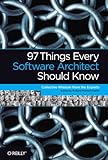
In this truly unique technical book, today's leading software architects present valuable principles on key development issues that go way beyond technology. More than four dozen architects -- including Neal Ford, Michael Nygard, and Bill de hOra -- offer advice for communicating with stakeholders, eliminating complexity, empowering developers, and many more practical lessons they've learned from years of experience. Among the 97 principles in this book, you'll find useful advice such as:
- Don't Put Your Resume Ahead of the Requirements (Nitin Borwankar)
- Chances Are, Your Biggest Problem Isn't Technical (Mark Ramm)
- Communication Is King; Clarity and Leadership, Its Humble Servants (Mark Richards)
- Simplicity Before Generality, Use Before Reuse (Kevlin Henney)
- For the End User, the Interface Is the System (Vinayak Hegde)
- It's Never Too Early to Think About Performance (Rebecca Parsons)
To be successful as a software architect, you need to master both business and technology. This book tells you what top software architects think is important and how they approach a project. If you want to enhance your career, 97 Things Every Software Architect Should Know is essential reading.
Price: $20.98
You Save: $14.01 (40%)
-
In this truly unique technical book, today's leading software architects present valuable principles on key development issues that go way beyond technology. More than four dozen architects -- including Neal Ford, Michael Nygard, and Bill de hOra -- offer advice for communicating with stakeholders, eliminating complexity, empowering developers, and many more practical lessons they've learned from years of experience. Among the 97 principles in this book, you'll find useful advice such as:
- Don't Put Your Resume Ahead of the Requirements (Nitin Borwankar)
- Chances Are, Your Biggest Problem Isn't Technical (Mark Ramm)
- Communication Is King; Clarity and Leadership, Its Humble Servants (Mark Richards)
- Simplicity Before Generality, Use Before Reuse (Kevlin Henney)
- For the End User, the Interface Is the System (Vinayak Hegde)
- It's Never Too Early to Think About Performance (Rebecca Parsons)
To be successful as a software architect, you need to master both business and technology. This book tells you what top software architects think is important and how they approach a project. If you want to enhance your career, 97 Things Every Software Architect Should Know is essential reading.
by Neal Ford
 List Price:
 $32.95
Price: $25.04
You Save: $7.91 (24%)
-
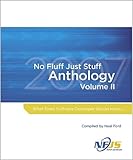
Twenty-seven weekends a year, the No Fluff, Just Stuff conference rolls into another town, featuring the world's best technical speakers and writers. Up until now, you had to go to one of the shows to soak up their collective wisdom. Now, you can hold it in the palm of your hand. The No Fluff, Just Stuff Anthology represents topics presented on the tour, written by the speakers who created it. This book allows the authors the chance to go more in depth on the subjects for which they are passionate. It is guaranteed to surprise, enlighten, and broaden your understanding of the technical world in which you live.
The No Fluff, Just Stuff Symposium Series is a traveling conference series for software developers visiting 27 cities a year. No Fluff has put on over 75 symposia throughout the U.S. and Canada, with more than 12,000 attendees so far. Its success has been a result of focusing on high quality technical presentations, great speakers, and no marketing hype. Now this world-class material is available to you in print for the first time.
Price: $25.04
You Save: $7.91 (24%)
-
Twenty-seven weekends a year, the No Fluff, Just Stuff conference rolls into another town, featuring the world's best technical speakers and writers. Up until now, you had to go to one of the shows to soak up their collective wisdom. Now, you can hold it in the palm of your hand. The No Fluff, Just Stuff Anthology represents topics presented on the tour, written by the speakers who created it. This book allows the authors the chance to go more in depth on the subjects for which they are passionate. It is guaranteed to surprise, enlighten, and broaden your understanding of the technical world in which you live.
The No Fluff, Just Stuff Symposium Series is a traveling conference series for software developers visiting 27 cities a year. No Fluff has put on over 75 symposia throughout the U.S. and Canada, with more than 12,000 attendees so far. Its success has been a result of focusing on high quality technical presentations, great speakers, and no marketing hype. Now this world-class material is available to you in print for the first time.
by Mark Richards
 List Price:
 $25.00
Price: $22.04
You Save: $2.96 (12%)
-
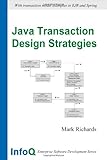
Understanding how transaction management works in Java and developing an effective transaction design strategy can help to avoid data integrity problems in your applications and databases and ease the pain of inevitable system failures. This book is about how to design an effective transaction management strategy using the transaction models provided by Java-based frameworks such as EJB and Spring. Techniques, best practices, and pitfalls with each transaction model will be described. In addition, transaction design patterns will bring all these concepts and techniques together and describe how to use these models to effectively manage transactions within your EJB or Spring-based Java applications. The book covers: - The local transaction model - The programmatic transaction model - The declarative transaction model - XA Transaction Processing - Transaction Design Patterns
Price: $22.04
You Save: $2.96 (12%)
- Understanding how transaction management works in Java and developing an effective transaction design strategy can help to avoid data integrity problems in your applications and databases and ease the pain of inevitable system failures. This book is about how to design an effective transaction management strategy using the transaction models provided by Java-based frameworks such as EJB and Spring. Techniques, best practices, and pitfalls with each transaction model will be described. In addition, transaction design patterns will bring all these concepts and techniques together and describe how to use these models to effectively manage transactions within your EJB or Spring-based Java applications. The book covers: - The local transaction model - The programmatic transaction model - The declarative transaction model - XA Transaction Processing - Transaction Design Patterns