SpringOne 2GX 2011
Chicago, October 25-28, 2011


 Magnificent Mile Marriott
Downtown Chicago
540 North Michigan Ave.
Chicago, Illinois 60611
1 (800) 228-9290
[ Map it ]
Robert Fischer
Java Concurrency Specialist and GORM Expert; Principal, Smokejumper Consulting


Robert Fischer is a multi-language open source developer currently specializing in Groovy in Grails. In the past, his specialties have been in Perl, Java, Ruby, and OCaml. In the future, his specialty will probably be F# or (preferably) a functional JVM language like Scala or Clojure.
Robert is the author of Grails Persistence in GORM and GSQL, a regular contributor to GroovyMag and JSMag, the founder of the JConch Java concurrency library, and the author/maintainer of Liquibase-DSL and the Autobase database migration plugin for Grails.
Robert is the author of Grails Persistence in GORM and GSQL, a regular contributor to GroovyMag and JSMag, the founder of the JConch Java concurrency library, and the author/maintainer of Liquibase-DSL and the Autobase database migration plugin for Grails.
Presentations
A Practical Take on GORM
For years, the venerable Hibernate object-relational mapping framework has dominated the persistence scene in Java. The Grails web application framework extended Hibernate and Spring with their impressive GORM persistence framework, providing convention-omore »Grails for the Enterprise
The Grails web application is an innovative hybrid of best-of-breed Java technologies and dynamic/convention-based development. The result is a powerful, flexible, exciting framework that still fits comfortably into enterprise stacks. more »A Practical Take on GORM

 By Robert Fischer
For years, the venerable Hibernate object-relational mapping framework has dominated the persistence scene in Java. The Grails web application framework extended Hibernate and Spring with their impressive GORM persistence framework, providing convention-over-configuration development to the O/RM and DAO layers.
This session will move through a quick introduction of GORM, HQL, and the GORM plugins.

Grails for the Enterprise
By Robert Fischer
The Grails web application is an innovative hybrid of best-of-breed Java technologies and dynamic/convention-based development. The result is a powerful, flexible, exciting framework that still fits comfortably into enterprise stacks.
This session introduces Grails, but approaches it from the perspective of an enterprise web development stack, in order to see how Grails works well in mid-size and mature development shops.
Books
by Robert Fischer
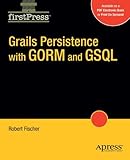
 Price: $19.99
-
Published with the developer in mind, firstPress technical briefs explore emerging technologies that have the potential to be critical for tomorrow's industry. Apress keeps developers one step ahead by presenting key information as early as possible in a PDF of 150 pages or less.
This Grails Persistence with GORM and GSQL firstPress is the first book on Grails Persistence anywhere; and gets readers rolling with the learning and using GORM, GSQL, HQL and other APIs and tools for maximizing Grails Web applications that use transactions with database accessibility.
There is no other book like this.
Price: $19.99
-
Published with the developer in mind, firstPress technical briefs explore emerging technologies that have the potential to be critical for tomorrow's industry. Apress keeps developers one step ahead by presenting key information as early as possible in a PDF of 150 pages or less.
This Grails Persistence with GORM and GSQL firstPress is the first book on Grails Persistence anywhere; and gets readers rolling with the learning and using GORM, GSQL, HQL and other APIs and tools for maximizing Grails Web applications that use transactions with database accessibility.
There is no other book like this.
- NFJS SITES:
- No Fluff Just Stuff
- Uber Conf
- NFJS One
- SpringOne 2GX
- Rich Web Experience
- Project Automation Experience
- SPRINGSOURCE SITES:
- Springsource.com
- Springsource.org
© 2011 No Fluff, Just Stuff TM and SpringSource, a division of VMware. All rights reserved. Java is a registered trademark of Oracle.