SpringOne 2GX 2011
Chicago, October 25-28, 2011

Early Bird ends Sept 12th
Save $200
Register Today!

 Magnificent Mile Marriott
Downtown Chicago
540 North Michigan Ave.
Chicago, Illinois 60611
1 (800) 228-9290
[ Map it ]
Joseph Nusairat
Co-Author of Beginning Groovy & Grails

Joseph Faisal Nusairat, author of "Beginning JBoss Seam" and co-author "Beginning Groovy & Grails", is a Java developer who has been working full time in the Columbus Ohio area since 1998, primarily focused on Java development. His career has taken him into a variety of Fortune 500 industries including military applications, data centers, banking, internet security, pharmaceuticals, and insurance. Joseph is particularly fond of open source projects and tries to use as much open source software as possible when working with clients. Joseph is a graduate of Ohio University with dual degrees in Computer Science and Microbiology with a minor in Chemistry. Currently, Joseph works as a Senior Partner at Integrallis Software (www.integrallis.com).
Presentations
Spring Web Flow in Grails
This presentation will go over how to use Spring Web Flow in Grails to make easy to use page flow based applications. more »Using GORM With Spring
Ever since Grails came out a few years ago it has grown in excitement and expectations. Grails allows an easy ability for developers to create applications in a faster pace. For Java developers it was even more exceptional because they were able to leveramore »Spring Web Flow in Grails

 By Joseph Nusairat
This presentation will go over how to use Spring Web Flow in Grails to make easy to use page flow based applications.
One of the hottest new features coming out of the spring team is Spring Web Flow. With the 2.0 released recently, it will start to gain even more support. What is Spring Web Flow you ask? Simply it is a way one can easily construct the flow of the website without having to make the services aware of what page the service should forward to next. However, this is not just about controlling the flow, with Spring Web Flow one is able to keep state of the objects for the duration of the flow, one is able to stop someone from entering in the middle of the flow, and most importantly one can create alternate paths inside the flow. All of these features give your application added functionality that it didn't have before and with less code than would take for one to implement by themselves.
So what's the downside to Spring Web Flow? It's written and defined in XML. However, with the Spring Web Flow integration with Grails that will not be the case. We are able to design flows with Groovy for a truly readable representation. Using the groovy builder syntax to define the flow, this presentation will show how one uses Spring Web Flow and how easy it is to integrate it inside our Grails applications.

Using GORM With Spring
By Joseph Nusairat
Ever since Grails came out a few years ago it has grown in excitement and expectations. Grails allows an easy ability for developers to create applications in a faster pace. For Java developers it was even more exceptional because they were able to leverage technologies most were already familiar with, Hibernate and Spring. Especially interesting was the use of Grails Object Relational Mapping (GORM), GORM is the database persistence layer behind GRAILS. This allows for creating dynamic queries that are easily readable like "User.findByFirstAndLast(..)", which will generate a query to find by the columns first and last. Using queries like this makes it very quick and easy to create queries, especially with criteria queries. So what's the downside? We HAVE to use Grails. For some newer apps this may not be an issue. But a legacy application or an organization that does not want to jump down the dynamic path THAT fast it can be an issue. Well no more, with Grails 1.1 the ability to use GORM with a regular spring application is now realized.
In this presentation we will show how to use GORM in your normal day to day Spring app and how GORM will be able to cut down on development time and increase code cleanliness in your Spring application. We will cover how to use GORM and how to integrate GORM with a regular Java Spring app.
Books
by Christopher M. Judd, Joseph Faisal Nusairat, and James Shingler
 List Price:
 $42.99
Price: $28.37
You Save: $14.62 (34%)
-
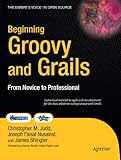
The Rails web framework has taken the software industry by storm, offering legions of web developers the ability to create web sites faster and more efficiently than ever before. But taking advantage of Rails means learning an entirely new paradigm, in addition to the language Rails is built upon: Ruby. Accordingly, other developer communities have implemented their own versions of Rails, but built using their preferred language. For millions of Java developers, this native framework is Grails, and the Java-centric scripting language its built upon: Groovy.
Beginning Groovy and Grails introduces Java developers to this popular framework and scripting language by guiding readers through the creation of a series of real-world projects. Each project introduces a new facet of Grails and Groovy, and affords readers the ability to download and experiment with the code. Authored by industry veterans Christopher Judd, Joseph Faisal Nusairat, and Jim Shingler, readers are treated not only to profound knowledge of the topic, but also to considerable insight shared as a result of the authors’ combined decades of Java experience.
See the following resources for more information on Grails and Groovy:
Grails project website: http://grails.codehaus.org/
Groovy project web site: http://groovy.codehaus.org/
List Price: $42.99
Price: $28.37
You Save: $14.62 (34%)
Price: $28.37
You Save: $14.62 (34%)
-
The Rails web framework has taken the software industry by storm, offering legions of web developers the ability to create web sites faster and more efficiently than ever before. But taking advantage of Rails means learning an entirely new paradigm, in addition to the language Rails is built upon: Ruby. Accordingly, other developer communities have implemented their own versions of Rails, but built using their preferred language. For millions of Java developers, this native framework is Grails, and the Java-centric scripting language its built upon: Groovy.
Beginning Groovy and Grails introduces Java developers to this popular framework and scripting language by guiding readers through the creation of a series of real-world projects. Each project introduces a new facet of Grails and Groovy, and affords readers the ability to download and experiment with the code. Authored by industry veterans Christopher Judd, Joseph Faisal Nusairat, and Jim Shingler, readers are treated not only to profound knowledge of the topic, but also to considerable insight shared as a result of the authors’ combined decades of Java experience.
See the following resources for more information on Grails and Groovy:
Grails project website: http://grails.codehaus.org/
Groovy project web site: http://groovy.codehaus.org/
by Christopher M. Judd, Joseph Faisal Nusairat, and Jim Shingler
 List Price:
 $34.39
Price: $28.24
You Save: $14.75 (34%)
-
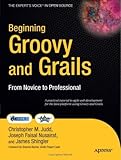
The Rails web framework has taken the software industry by storm, offering legions of web developers the ability to create web sites faster and more efficiently than ever before. But taking advantage of Rails means learning an entirely new paradigm, in addition to the language Rails is built upon: Ruby. Accordingly, other developer communities have implemented their own versions of Rails, but built using their preferred language. For millions of Java developers, this native framework is Grails, and the Java-centric scripting language its built upon: Groovy.
Beginning Groovy and Grails introduces Java developers to this popular framework and scripting language by guiding readers through the creation of a series of real-world projects. Each project introduces a new facet of Grails and Groovy, and affords readers the ability to download and experiment with the code. Authored by industry veterans Christopher Judd, Joseph Faisal Nusairat, and Jim Shingler, readers are treated not only to profound knowledge of the topic, but also to considerable insight shared as a result of the authors’ combined decades of Java experience.
See the following resources for more information on Grails and Groovy:
Grails project website: http://grails.codehaus.org/
Groovy project web site: http://groovy.codehaus.org/
List Price: $34.39
Price: $28.24
You Save: $14.75 (34%)
Price: $28.24
You Save: $14.75 (34%)
-
The Rails web framework has taken the software industry by storm, offering legions of web developers the ability to create web sites faster and more efficiently than ever before. But taking advantage of Rails means learning an entirely new paradigm, in addition to the language Rails is built upon: Ruby. Accordingly, other developer communities have implemented their own versions of Rails, but built using their preferred language. For millions of Java developers, this native framework is Grails, and the Java-centric scripting language its built upon: Groovy.
Beginning Groovy and Grails introduces Java developers to this popular framework and scripting language by guiding readers through the creation of a series of real-world projects. Each project introduces a new facet of Grails and Groovy, and affords readers the ability to download and experiment with the code. Authored by industry veterans Christopher Judd, Joseph Faisal Nusairat, and Jim Shingler, readers are treated not only to profound knowledge of the topic, but also to considerable insight shared as a result of the authors’ combined decades of Java experience.
See the following resources for more information on Grails and Groovy:
Grails project website: http://grails.codehaus.org/
Groovy project web site: http://groovy.codehaus.org/
by Joseph Faisal Nusairat
 List Price:
 $39.99
Price: $26.39
You Save: $13.60 (34%)
-
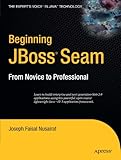
JBoss Seam represents the primary counter to the hot and successful Spring Framework and perhaps even Ruby on Rails framework. The open source lightweight Java EE 5 standards based JBoss Seam framework is a part of this second wave of open source lightweight Java that’s taking place.
Beginning JBoss Seam: From Novice to Professional aims to take advantage of this hot area, and aims to be first beginning book and one of maybe two books to market in this likely lucrative area.
This book gives an overview of Seam related JSF and EJB 3 as found in Java EE 5; provides information on the tools to make development with Seam easier as well as a functioning in depth demo to truly learn how to use Seam; and gives tips and tricks to using Seam.
List Price: $39.99
Price: $26.39
You Save: $13.60 (34%)
Price: $26.39
You Save: $13.60 (34%)
-
JBoss Seam represents the primary counter to the hot and successful Spring Framework and perhaps even Ruby on Rails framework. The open source lightweight Java EE 5 standards based JBoss Seam framework is a part of this second wave of open source lightweight Java that’s taking place.
Beginning JBoss Seam: From Novice to Professional aims to take advantage of this hot area, and aims to be first beginning book and one of maybe two books to market in this likely lucrative area.
This book gives an overview of Seam related JSF and EJB 3 as found in Java EE 5; provides information on the tools to make development with Seam easier as well as a functioning in depth demo to truly learn how to use Seam; and gives tips and tricks to using Seam.
- NFJS SITES:
- No Fluff Just Stuff
- Uber Conf
- NFJS One
- SpringOne 2GX
- Rich Web Experience
- Project Automation Experience
- SPRINGSOURCE SITES:
- Springsource.com
- Springsource.org
© 2011 No Fluff, Just Stuff TM and SpringSource, a division of VMware. All rights reserved. Java is a registered trademark of Oracle.